Introduction:
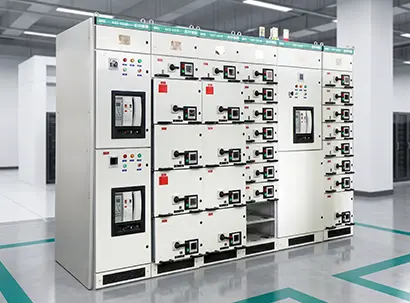
Distribution automation is changing how power systems operate. In this process, the role of vacuum circuit breakers (VCBs) is undergoing a fundamental shift — from switching devices requiring on-site manual operation to intelligent nodes capable of remote control, real-time monitoring, and automatic diagnostics. This article explores how smart VCBs function in distribution networks from a practical, field-oriented perspective.
1. From "Switch" to "Node": The Evolution of the Breaker's Role
In the past, the role of a circuit breaker was simple: trip on faults, disconnect during maintenance. Operators had to be physically present to operate the device, either manually or through local control panels. This approach worked when equipment counts were low and network structures were simple.
But things are different now.
Distribution networks have multiplied in size and complexity. Customer expectations for reliability have never been higher. The traditional maintenance model — reliant on manual on-site intervention — can no longer keep up.
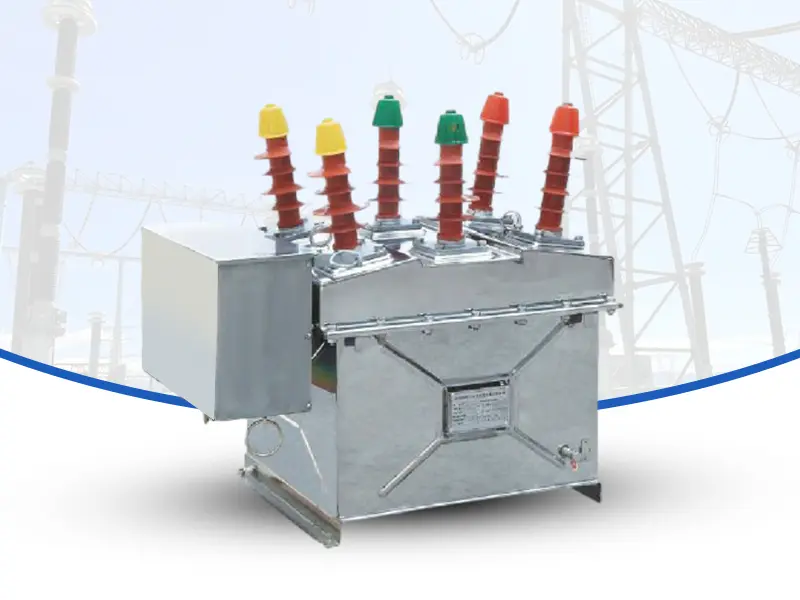
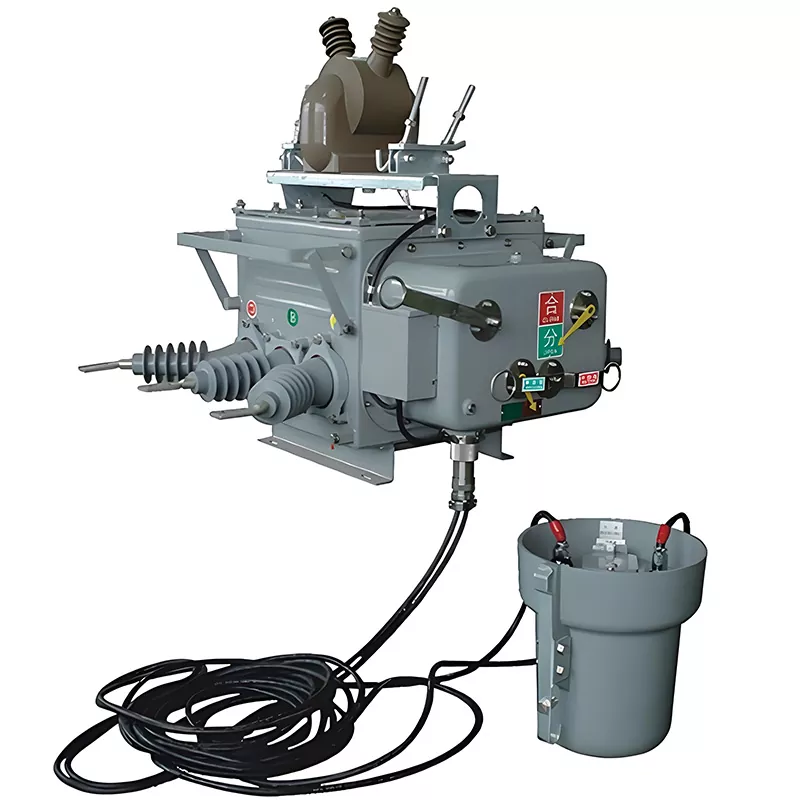
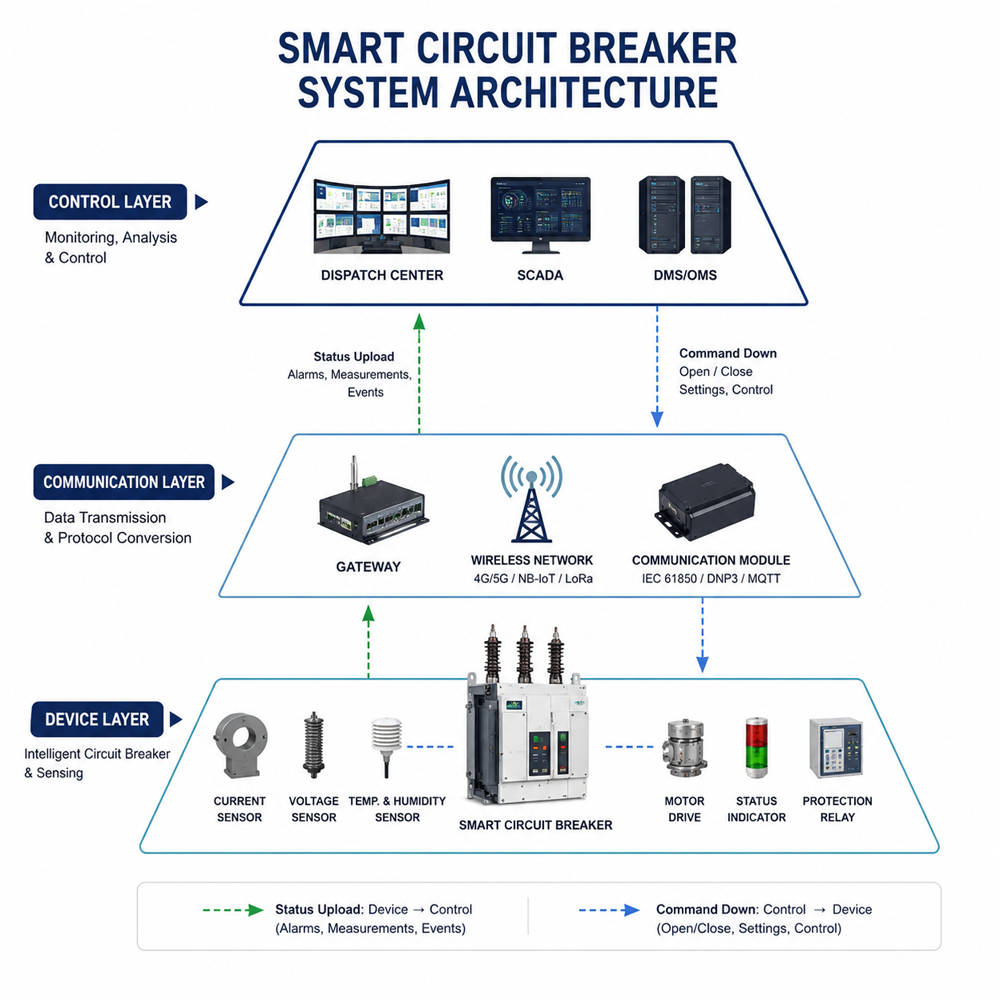
Smart vacuum circuit breakers solve this problem. While retaining the proven vacuum interrupter technology, they integrate motor-operated mechanisms, sensors, and communication modules, giving the device three essential capabilities: controllable, observable, and communicable.
2. Remote Control: Reducing On-Site Intervention, Shortening Response Times
The most immediate value of smart vacuum circuit breakers lies in remote control.
Conventional breakers require operators to be physically present for open/close operations. After a dispatch command is issued, it can take hours for crews to reach remote sites. For transient faults, the time spent waiting for on-site operations often exceeds the outage time caused by the fault itself.
Smart breakers allow dispatch centers to send open/close commands directly. Through fiber optic or wireless communication networks, operations can be completed in seconds — no longer constrained by geography or crew availability. For scenarios requiring fast fault isolation or power restoration, this capability directly determines outage scope and recovery time.
In areas with robust fiber coverage, operations experience virtually no delay. Even in remote locations with only mobile network coverage, reliable control can be achieved through 4G/LTE public networks. The communication medium can be adapted to site conditions — the key requirement is that control commands reach their destination reliably.
3. Condition Monitoring: Turning Equipment Health Into Visible Data
The service life of a circuit breaker largely depends on the mechanical condition of its operating mechanism and the vacuum integrity of the interrupter. Neither is visible. The traditional approach is time-based preventive maintenance — regardless of equipment condition, inspections and overhauls happen on schedule.
This approach has two problems: well-functioning equipment receives unnecessary maintenance, wasting resources; and equipment already developing issues may not be discovered until the next scheduled inspection, by which time a failure may have already occurred.
Smart breakers embed sensors that continuously monitor mechanical parameters — operating time, travel, spring charge status — as well as vacuum integrity. When this data is reported to the back-end system, it forms a trend line. When a parameter deviates from its normal range, the system can issue early warnings, allowing maintenance crews to intervene before a failure occurs.
The transition from "time-based maintenance" to "condition-based maintenance" is built on data.
4. Communication and Integration: Joining Existing Systems, Not Building a New One
Whether a smart breaker can be readily accepted by existing systems determines its practical value.
The standard approach is to support open communication protocols. Modbus covers the most basic industrial needs, while IEC 60870-5-104 or DNP3 address utility-grade requirements. This means smart breakers can integrate into existing SCADA systems and Distribution Management Systems (DMS). Dispatchers see breaker status and issue commands through the same interface they already use — no additional training or separate monitoring platforms required.
For users with mature SCADA systems, smart breakers can join as new data nodes. For those still building their automation infrastructure, basic remote monitoring and control can be achieved with simple gateway devices.
5. Fault Diagnostics and Waveform Recording: Evidence for Post-Fault Analysis
After a breaker trips, field crews typically need to answer several questions: What caused the trip? Which section of the line experienced the fault? Did the breaker operate correctly?
Conventional breakers provide none of this information. Crews must rely on site inspection, visual judgment, and experience to piece together what happened.
Smart breakers record critical data when a fault occurs — current waveforms, operating times, interrupted current levels. This data helps quickly determine the fault type: transient or permanent? Line-related or equipment-related? For permanent faults, waveform data can also help locate the fault section, reducing patrol range.
For post-fault analysis, these records are as valuable as a full on-site investigation.
6. Practical Deployment Considerations
Several practical issues are unavoidable when deploying smart breakers:
Communication infrastructure availability is the first prerequisite. Whether fiber, private wireless, or public 4G, reliable communication coverage must exist at each site. A practical on-site assessment is recommended — not just paper records.
The shift in operating habits should not be underestimated. Teams accustomed to on-site operations need time and training to adapt to remote control. The most effective transition approach is to start with a small pilot, letting teams gain hands-on experience with the remote control workflow and its boundaries.
Power supply reliability is another practical consideration. Control and communication modules need stable power. Substations have reliable DC battery systems, but for pole-mounted outdoor installations, solutions may include low-voltage side tapping or solar panels with battery backup.
Cybersecurity is also critical. When remote-controlled devices connect to public networks, authentication, encryption, and access control must be addressed.
7. Final Thoughts
Smart vacuum circuit breakers are not a revolution that replaces traditional breakers — they are an evolution. The vacuum interrupter itself is a mature and reliable technology. The addition of intelligence gives it new capabilities that meet current distribution network demands: remote control, real-time awareness, and system coordination.
The pace of distribution automation depends largely on whether field devices have communication and control interfaces. From this perspective, smart breakers are not just equipment — they are the underlying infrastructure of distribution automation.
-